Guides
A renter's resource centre for small-space organization
Ten guides for renters. Each one starts with the problem, gives you the measurements to take, walks the decision in order, and then shows what we'd shop for it.
Foundations
Read these first — they decide what fits and what holds.
Measure These Six Things Before You Buy Any Organizer
Most returned organizers were the right product in the wrong dimension. This is the six-measurement list we run before any product type earns a card on this site.
The short version
- Rod height and garment drop decide whether a closet doubler is usable at all.
- Depth kills more purchases than width — measure to the obstruction, not the wall.
- Doors, drawers, and valves need swing clearance that the product listing never mentions.
No-Drill Storage That Actually Holds: What Fails and Why
Adhesive, tension, magnetic, and over-door mounts each fail in a predictable way. Once you know the failure mode, choosing between them stops being guesswork.
The short version
- Adhesive fails in shear over time — hang light, hang low, hang vertical loads.
- Tension fittings lose grip on textured, glossy, or freshly painted surfaces.
- Over-door hardware transfers load into the hinge, which is the real weight limit.
The Renter-Safe Mounting Guide: Deposits, Damage, and Load
Deposit deductions come from surface damage, not from the existence of a hook. Choosing by surface — and removing correctly — is most of the game.
The short version
- Removal technique causes more paint damage than installation ever does.
- Wallpaper and freshly painted walls are the two highest-risk surfaces.
- Document the wall before and after; photos settle disputes cheaply.
The Best Storage Solutions for Small Apartments
The best storage solutions for small apartments are the ones that fit an awkward dimension you already have. This is our room-by-room shortlist, with the tradeoff for each type stated up front.
The short version
- The best small-apartment storage adds vertical capacity without touching the floor plan.
- Closet baskets, over-door shelving and under-sink pullouts solve the four spaces that fail first.
- Every pick here depends on one measurement — take it before you shop, not after delivery.
Bedroom & closet
One shallow rod, one shelf, and the shoes on the floor.
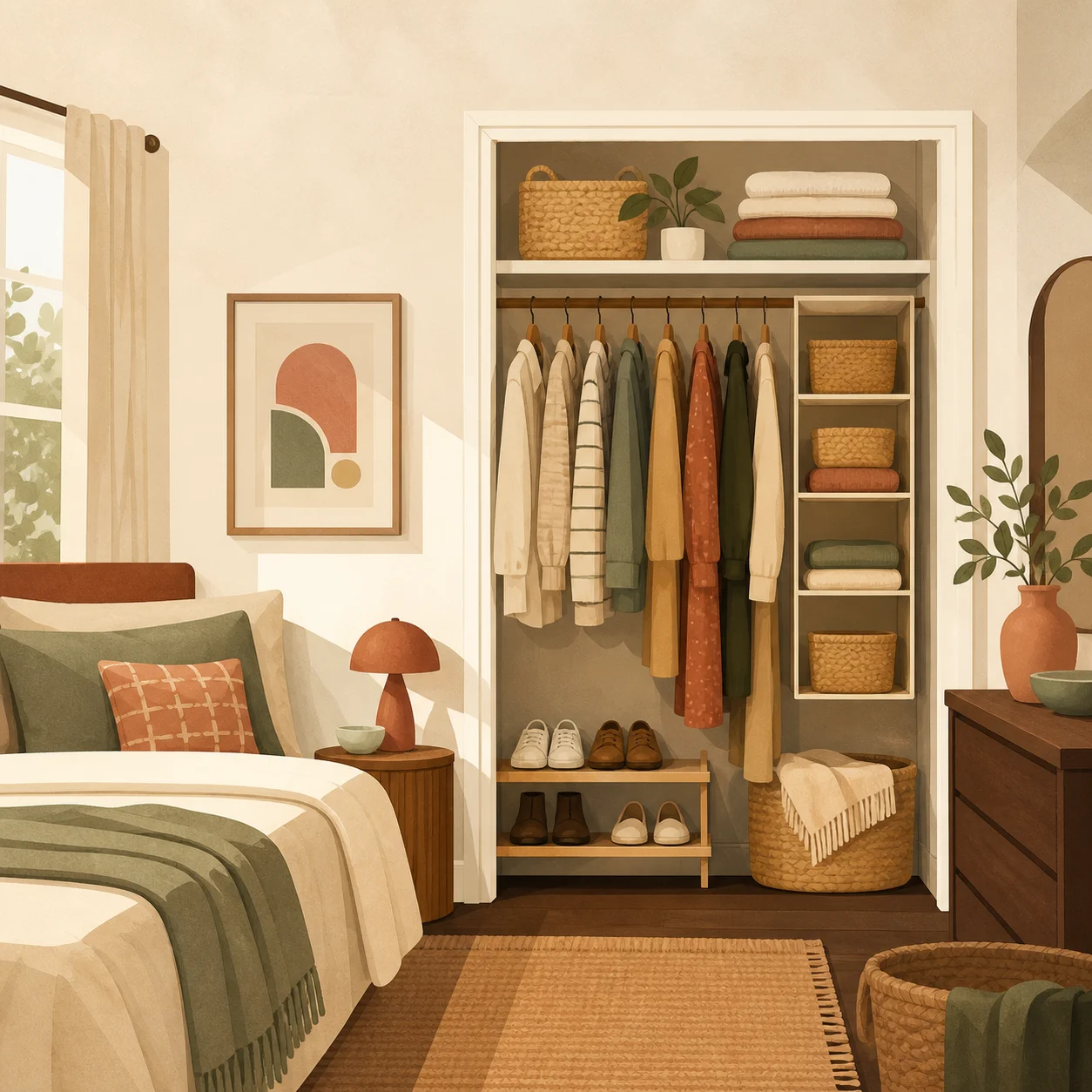
Small Apartment Closet Organization Without Rebuilding Anything
One rod, one shelf, and a door that half-opens. That is the standard rental closet, and it can hold far more than it does — but only if you decide the zones before buying containers.
The short version
- Measure garment drop before assuming a second rod will fit.
- Dead air above the shelf is the largest unused volume in most closets.
- Containers should be chosen after zoning, never before.
Shoe Storage for Apartments Without a Hallway
Shoes are the clutter people see first because they sit at eye level when you walk in. Solving them is mostly a question of where the pile currently forms.
The short version
- Count pairs in active rotation, not total pairs — they need different storage.
- Depth is the binding constraint behind a door; height is the constraint in a closet.
- Open racks beat closed boxes for anything worn more than twice a week.
Bathroom
Planning around plumbing, damp, and tile you cannot drill.
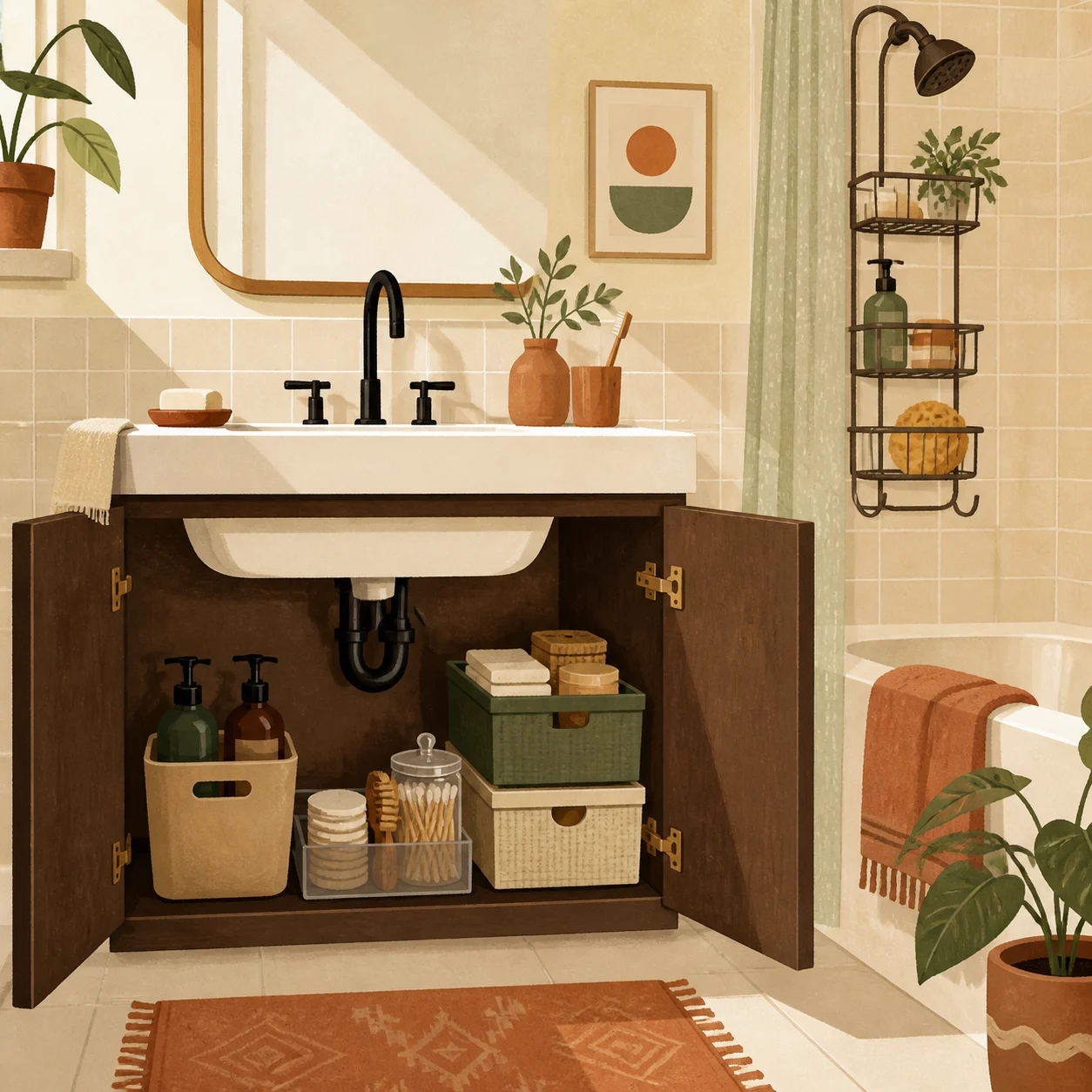
Planning Under-Sink Storage Around the Drain Pipe
The trap pipe is the design brief, not an obstacle to work around later. Three cabinet layouts cover almost every apartment, and each one points to a different shelving type.
The short version
- Centre-trap cabinets need split or expandable frames, not a single shelf.
- Side-trap cabinets suit one pull-out drawer stack on the clear side.
- Never plan storage that blocks a shut-off valve — you will need it in a hurry one day.
Kitchen & pantry
Two cabinets, no pantry, and no spare counter.
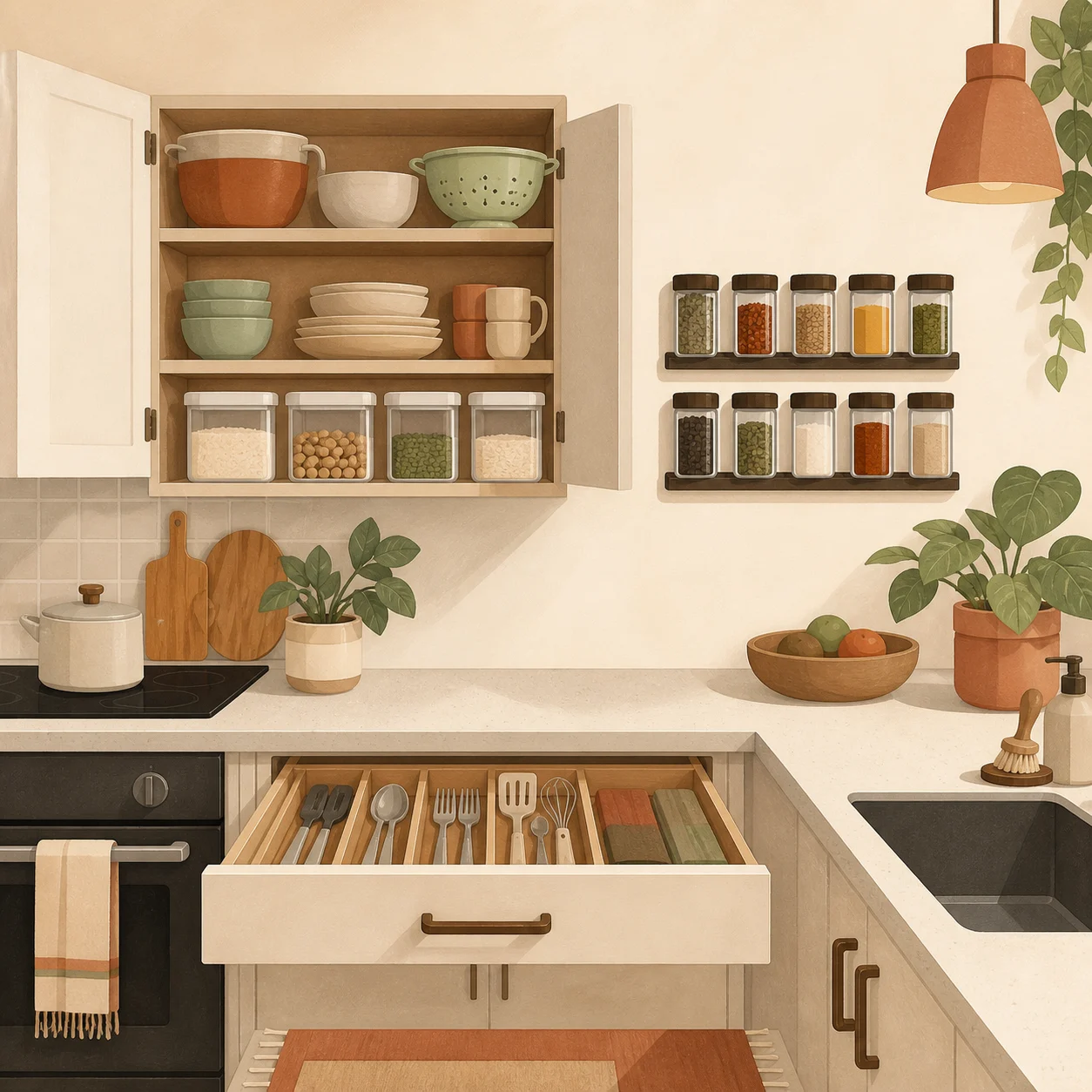
Organizing a Small Kitchen With No Pantry
With no pantry, every cabinet does two jobs badly. The way out is to move the small, frequently used things onto vertical and magnetic surfaces so the cabinets can hold bulk.
The short version
- Spices and utensils are the highest-frequency, lowest-volume items — move them out of cabinets first.
- Drawer dividers add more usable capacity per unit cost than any new shelf.
- Reserve one full cabinet shelf for bulk, and defend it.
Entry & laundry
Narrow gaps, no hallway, and everything you carry inside.
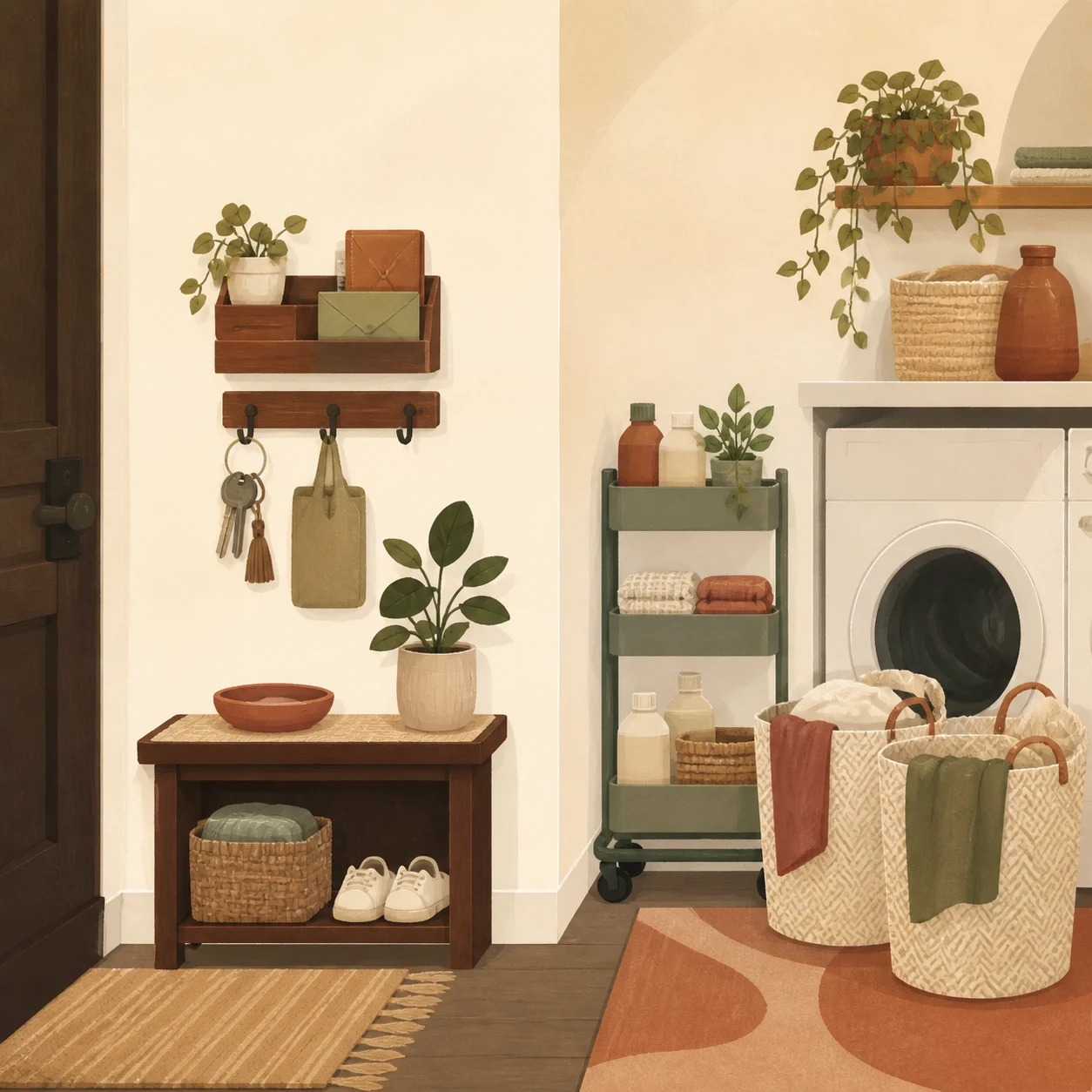
Slim Laundry Storage and the Gaps Between Appliances
The 20 cm gap beside a washing machine is the most over-promised space in a small apartment. It is usable — with two caveats most product listings never mention.
The short version
- Measure the gap at the back as well as the front; walls and pipes rarely run parallel.
- Never block an appliance vent, valve, or the hose loop behind the machine.
- Wheels matter more than capacity in a gap that needs to be emptied from the front.
Building an Entryway Where There Isn't One
Most apartments have no entryway, only a door. A working landing zone needs four jobs covered in under half a square metre.
The short version
- Keys, post, bags, and shoes are four separate jobs — solve them individually.
- Vertical wall beside the door is usually the only free real estate.
- A landing zone fails when it has no outbound path for post and paper.
Whole apartment
Sequencing the whole job so the apartment stays liveable.
A Four-Weekend Organization Plan for a Small Apartment
Doing the whole apartment at once guarantees an abandoned pile in the middle of the living room. Sequencing by room dependency finishes the job and keeps the space usable throughout.
The short version
- Start with the closet — it absorbs displaced items from every other room.
- Do the entry last, because it depends on shoes having somewhere to go.
- Buy nothing until the weekend you need it.
How these guides are written
Guides are written in-house from the measurements and constraints that come up again and again in small rentals. We recommend by fit first, always give an alternative, and never make claims about performance we can't stand behind. Always check dimensions against your own space before you buy.